
If you’re a dual citizen planning to travel to the UK after February 25th, 2026, there are important changes you need to be aware of before you book flights or arrive at the airport. This is because the rules around how you prove your right to enter the UK are tightening, and they’re already causing confusion and disruption for many Australian-British and Irish dual citizens.
What are the UK passport rule changes taking effect on February 25?
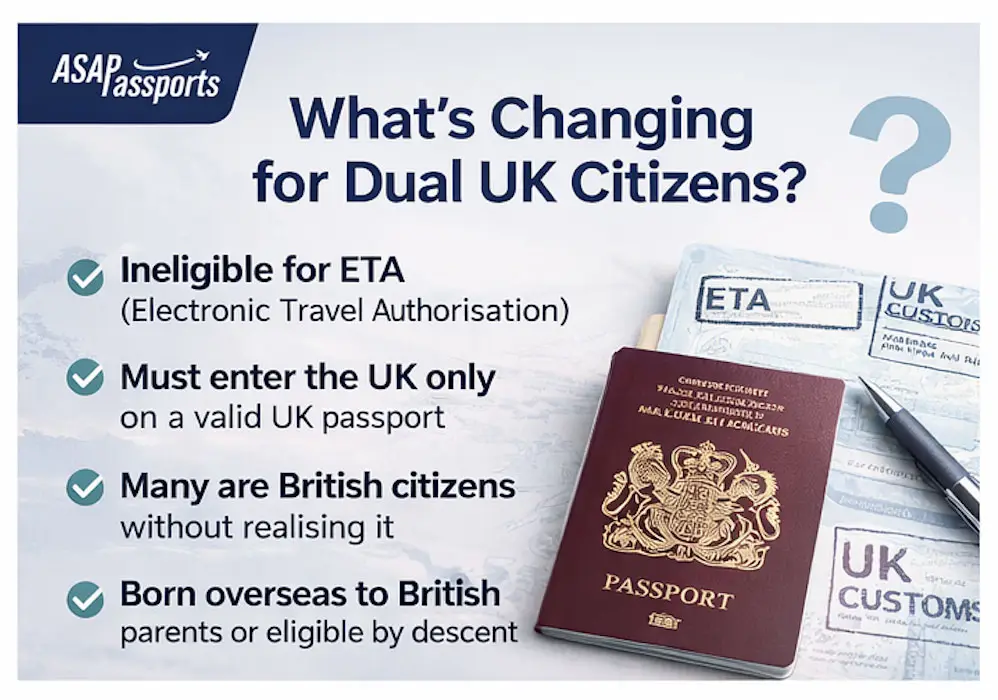
From February 25th, the UK will require anyone with British or Irish citizenship to show proof of citizenship when entering the country. That means dual citizens can no longer board a flight to the UK with just a passport from another country, such as an Australian passport.
Under the new rules, the only documents accepted at the UK border control will be:
- A valid UK passport
- A valid Irish passport
- A foreign passport that contains a Certificate of Entitlement (COE) confirming your Right of Abode in the UK
If you arrive at the airport without one of the above, airlines could refuse to let you board, and you may be denied entry.
Which dual citizens are affected by the new UK passport entry rules?

Australian and British dual citizens travelling to the UK
If you hold both Australian and British citizenship, the UK will now require you to prove your British nationality before you travel. That means you’ll need a UK passport or a Certificate of Entitlement stamped in your Australian passport. Travelling on an Australian passport alone will not give you automatic entry into the UK after February 25th.
UK and Irish dual citizens entering the UK
People holding both Irish and UK citizenship will be expected to enter the UK on either a UK passport or an Irish passport. This is because Irish citizens don’t need a visa to enter the UK, so showing an Irish passport is enough to establish your right to come and go.
British citizens living overseas without a UK passport
Some British citizens born or raised overseas have never had a UK passport, or haven’t renewed one in years. In this case, you’ll need to sort out a passport or Certificate of Entitlement before you travel, as there’s no longer an option to turn up at the airport and prove your citizenship in another way.
Can dual citizens enter the UK on an Australian passport after February 25?
No. From February 25th onwards, travelling to the UK on an Australian passport alone will no longer be sufficient for dual citizens. Airlines and border processes will expect evidence of British or Irish citizenship, which means you’ll need either a UK passport, an Irish passport, or an Australian passport that contains a valid Certificate of Entitlement. Without one of these, boarding may be refused at check-in.
What is a Certificate of Entitlement and when is it required to enter the UK?
A Certificate of Entitlement (COE) is an official document that proves your Right of Abode in the UK. It’s normally stamped into your non-UK passport and shows that you are legally entitled to live and work in the UK without any immigration restrictions. From February 25th, a COE in your Australian passport will be accepted by airlines and UK border control as proof of your right to enter the UK if you do not hold a valid UK passport. An Australian passport without a COE will not be accepted on its own.
Do UK dual citizens need a UK passport to enter the UK?
Not necessarily. Under the new rules, you must either have a valid UK passport or a Certificate of Entitlement linked to the foreign passport you’re travelling with. This isn’t technically a new citizenship rule, but it affects how the UK verifies your status before departure and on arrival.
What are the options for UK dual citizens affected by the passport changes?
Applying for a UK passport from Australia
If you don’t already have one, you can apply for a UK passport online from Australia. Just keep in mind that processing can take several weeks, so it’s best to apply as soon as possible.
Applying for a Certificate of Entitlement instead of a UK passport
A Certificate of Entitlement is an alternative if you don’t want or need a full UK passport. It’s a recognised way to demonstrate your Right of Abode, but tends to be more expensive and more complicated to obtain than a standard passport.
Renouncing UK citizenship and how it affects travel
Some dual citizens are considering renouncing their UK citizenship altogether following news of these upcoming changes. The process can take up to six months, and if accepted, you’ll receive a “Declaration of Renunciation” as proof that you’re no longer British.
It’s important to consider this very carefully, though. If you choose this path and are accepted, you’d no longer be subject to these very specific entry requirements, but you’d also lose the automatic right to live and work in the UK. It’s also important to note that you can only renounce British citizenship if you already have citizenship elsewhere.


How much does a UK passport, certificate of entitlement, or renunciation cost?
For most people, a standard adult UK passport is the most affordable solution for the upcoming changes. Fees vary by method, but average around £94.50 online for adults and £61.50 for children.
In total, you’ll spend around £589 for a Certificate of Entitlement, so it’s much more expensive than getting a UK passport. It does allow you to continue travelling on an Australian passport, though, so it’s a good option if you’d rather not apply for a separate passport.
If you’re considering renouncing British citizenship, the current renunciation fee is £482. Again, it’s important to remember that renouncing your UK citizenship permanently removes your automatic right to live and work in the UK, so it’s potentially a good last-resort option instead of a workaround for the new rules.
What happens if you already have travel booked to the UK after February 25?
If you’ve already booked and your travel date is after February 25th, now is the time to confirm your documentation. Airlines have already begun checking details before departure, and carriers can refuse boarding if your documentation doesn’t clearly prove your right to enter.
How do the new UK passport rules affect children born in Australia?
The rules apply to children in the same way they apply to adults, but citizenship status can be more complicated. Children born in Australia to a UK or Irish parent may be British or Irish citizens automatically, or they may need to be registered, depending on the parent’s citizenship status and how that citizenship was passed on.
From February 25th, children who are British or Irish citizens will still need the correct travel document to enter the UK, such as a UK passport, an Irish passport, or a passport containing a Certificate of Entitlement. With this in mind, parents should check their child’s citizenship status early and allow plenty of time to apply for the appropriate documentation before travelling.
Can UK dual citizens legally hold more than one passport?
Yes, the UK legally allows dual passports and dual citizenship. The upcoming rule changes apply to entering the UK, though, so if you’re travelling to the UK after February 25th, you’ll need a UK passport or a foreign passport with a Certificate of Entitlement to satisfy pre-departure checks and border control.
What happens if a UK citizen arrives without the correct passport?
If a UK citizen attempts to travel without the correct documentation, they may be stopped before boarding by the airline or face delays on arrival in the UK. Those without a valid UK passport, Irish passport, or Certificate of Entitlement may be subject to additional identity and nationality checks and may not be able to pass through passport control until their status is confirmed. These checks form part of the UK’s wider move towards digital border controls and tighter pre-departure screening.
Are these UK passport entry rules unusual compared to other countries?
Stricter documentation requirements are becoming increasingly common, and many countries have implemented tighter checks on how citizenship and travel rights are demonstrated. What’s new here is that the UK is more strictly enforcing its system, particularly in connection with ETAs and pre-departure checks that airlines must carry out. In practice, this means dual citizens need to pay more attention to which passport they’re travelling with.
Key things UK dual citizens need to do before travelling after February 25
Before travelling to the UK after February 25th, UK dual citizens should start their paperwork as soon as possible, especially if they don’t hold a valid UK passport. Applying from overseas can take longer than expected, and leaving it until the last minute could create a lot of issues.
It’s also important to double-check which documents apply to your specific circumstances. As we’ve outlined above, requirements can differ depending on the passports you currently hold, how you normally travel, and whether you plan to enter the UK on a UK passport, an Irish Passport, or a foreign passport with a Certificate of Entitlement.
If you’re unsure at any stage, it’s worth speaking with the relevant consulate or passport office before you travel. Getting that information early can help you avoid denied boarding or unexpected issues once you arrive.



Need a UK passport urgently before travelling?
If you need a UK passport urgently because of the February 25th rule changes, ASAP Passports specialises in fast-tracked UK passport applications for tight deadlines. Just complete an application form and upload your photo, securely send any required documents using an express courier, and our team will personally manage the application process with the HM Passport Office.
We’ll also collect the passport once it’s ready and arrange worldwide delivery. For dual citizens facing imminent travel, our hands-on, end-to-end service is the difference between travelling as planned and being stopped at the airport.